Archives
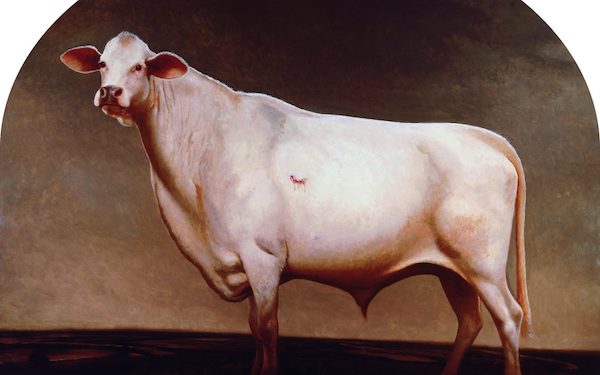 Calling
Although seemingly just a painting of a cow, there is more to this piece from 1998.
In this video, Bartlett discusses how this work is like a surreal self-portrait of
himself. With many small details and symbolism to find within the work, it is much
more than just a simple cow.
Check out Calling with Bo Bartlett
About the Painting
1998
Oil on linen
77 x 88
My cousin drove through a cow on the highway in Georgia--it flew up in the air and
came down on an oncoming car in the other lane, sheering the roof off and killing
the driver and the passenger.
In our screenplay, “Things Don't Stay Fixed” by Sandra Deer there is a scene where
Sam and Chris hug a cow on a highway at night under the full moon. Chris says that
cows are "full of forgiveness." Cows are otherworldly, like aliens. They seem to be
ignorant but at the same time seem perfectly content; are those eyes dumb or omniscient?
One can see why they are considered holy in the East. Simple complex powerful sacred
creatures.
I was thinking about Andrew Wyeth's "Young Bull," "Geurnica" and that bull on the
left. And of Titian's "Rape of Europa." The bull is Jupiter. The remnants of the sea
are still on the hill. The urchins, like balls, brought up from the depths of the
great feminine subconscious sea. I was trying to make it a self-portrait. The cow
has rubbed up against a fence ripping a wound in its side. The blood drips in the
shape of the Hebrew symbol for "life." (chai).
The cow in the picture 'is Howard' -- owned by the father of my nephew's wife. I photographed
him in Odom, GA, while I was down there for their wedding.
-Bo Bartlett
Childhood Home
Vernacular architecture is an important subject in Bo Bartlett’s painting and none
is more important that the southern suburban single house. For him the single house
becomes both a metaphor for place and home, as well as an archetypal form that he
constantly revisits in his sketchbooks and paintings. This page, from one of his sketchbooks
in the Bartlett Center archive, finds Bartlett’s keen eye capturing a corner of the
house where he grew up on 15th Avenue in Columbus, Georgia.
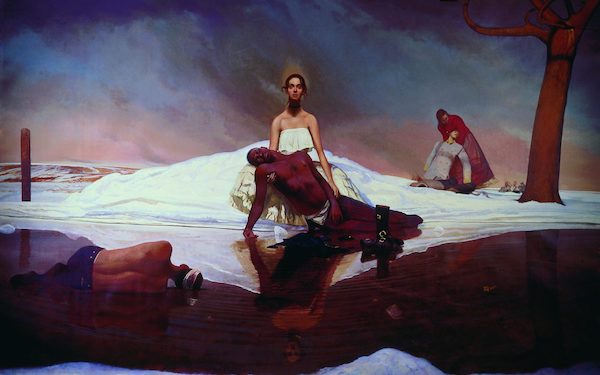 Civil War
This piece from 1994 depicts Bartlett’s coming to terms with displacement from the
South and used the Battle of Nashville as inspiration. Here, Bartlett focuses on themes
of race and injustice. Bartlett suggests that the viewer sees past the tragedy and
towards a better possible future through masterful painting techniques in light and
color.
Check out our artist talk for our exhibition, Civil War with Bo Bartlett
About the Painting
1994
Oil on Linen
134 x 204
For his second work in a series of war paintings, Bartlett was inspired by the Battle
of Nashville. The Confederate army was all but destroyed in this battle, one of the
few to be fought in the snow. At the center, an angelic Southern belle cradles a former
slave, now Union soldier, in a pose similar to Michelangelo's Pietà. In the background,
a woman ministers to a white Confederate soldier, while in the foreground another
fallen combatant lies with his back to the viewer. The field of white snow, unblemished
by the blood of the battle, shines bright as an indication of the reconciliation that
was to eventually come.
"This painting became an attempt to come to terms with my own displacement, a Southerner
living in the North. Home is a mercurial concept. It disappears and becomes insolvent.
The past holds a powerful nostalgic spell over us. Race became a central theme in
the painting by default. I morphed the central self-portrait into a black figure in
order to find the balance: coloristically, metaphorically and existentially."
Reference Photograph for Civil War
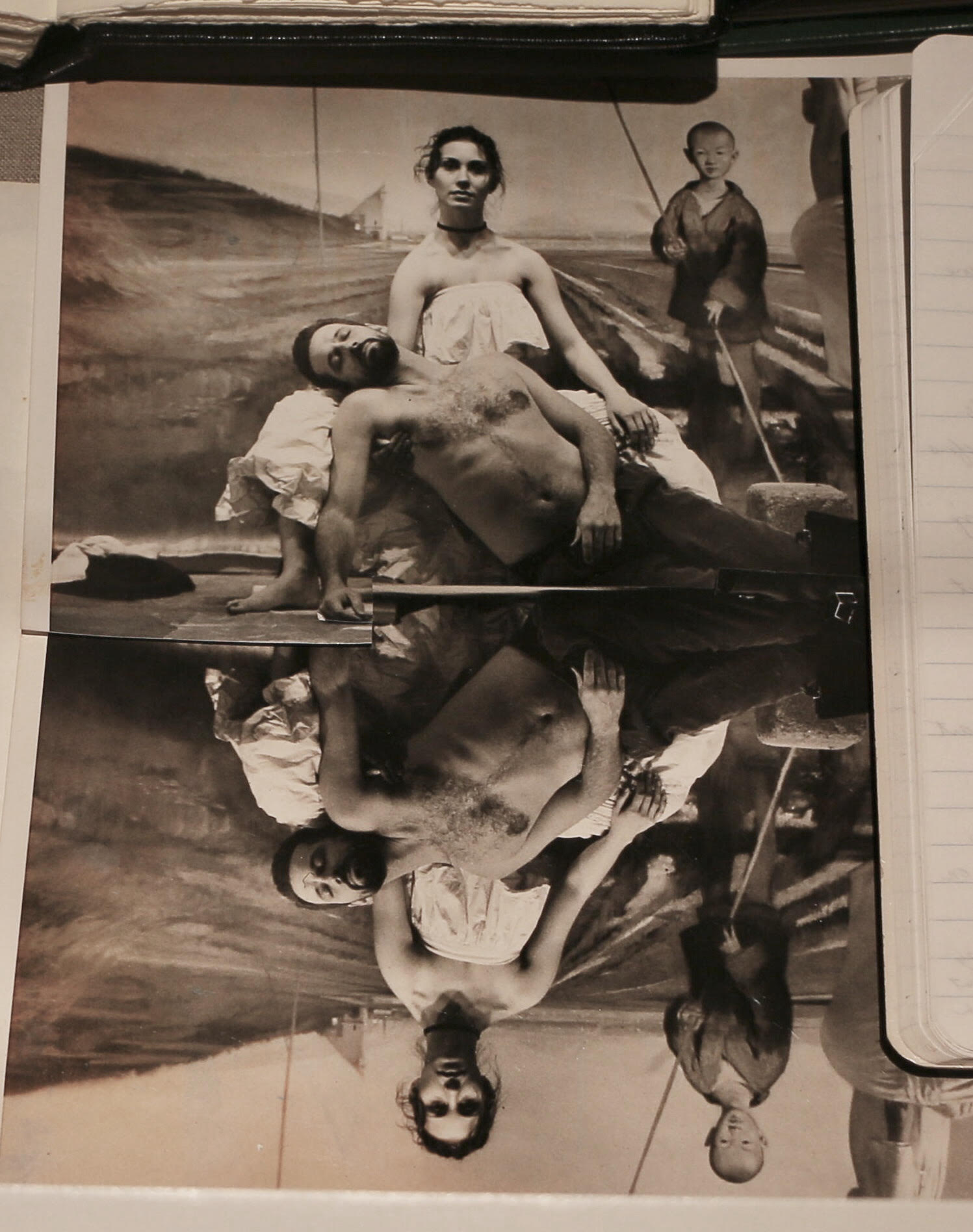
Throughout the ‘80s and ‘90s, Bartlett utilized film photography stills to help with
the positioning of models for his paintings. In the preparatory stages of a painting,
work began by completing compositional studies. Then the artist would have the models
pose while he drew finished charcoal and graphite studies from life. A preliminary
color study in gouache or oil was usually completed as a template prior to starting
the larger canvas.
To have the forms look as if they are being reflected in the melting snow in the painting,
Bartlett cut and taped two black and white photographs together positioning one upside
down below the other to create a mirror image. This image is telling in many ways
since his first painting after winning a PEW Fellowship grant, “Hiroshima,” is used
as a backdrop and it reveals that the artist himself had initially posed for the central
figure of the dying soldier. Both paintings from his 1993-1994 PEW grant are currently
on view in the Scarborough Gallery of The Bo Bartlett Center.
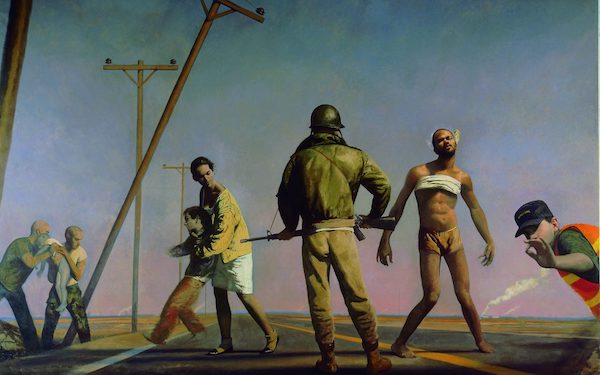 Damascus Road
Here, Bo Bartlett focuses on his piece from 1988, Damascus Road, which showcases a contemporary vision of the biblical story. Depicting tragedy and
ideas of systems being broken down, Bartlett alludes to ways in which society at the
time, and even now, was struggling to simmer down from turmoil.
Check out our artist talk for our exhibition, Damascus Road with Bo Bartlett
About the Painting
1988
Oil on linen
120 x 168
On Damascus Road, Saul of Tarsus experienced a conversion to Christianity on his way
to becoming the Apostle Paul. Bartlett sets what appears to be a tragic story on his
version of that road. In the center of the composition, a helmeted soldier with his
back to the viewer holds a gun. On the right, a mother drags her son off the road
towards two men holding a lifeless child. An enigmatic figure, his head surrounded
by a broken halo and his chest bound in the manner of Michelangelo’s Christ and slave
figures, seems on the point of collapse. On the right, an emergency worker warns the
view to stay back.
“Damascus Road still has resonance for me today. This is the hot bed, the boiling
pot, right now. The powder keg of what is going on, and it’s still happening right
in the same place. The point where divine intervention meets the the real world. You
get the conversion of Paul on Damascus Road, and, you see the telephone pole – the
lines of communication are breaking down.”
Military Flight Jacket used in Damascus Road
Bartlett bought this jacket at the Army supply store Ranger Joes when it was located
in the downtown district of his hometown of Columbus, Georgia, just two blocks away
from where The Bo Bartlett Center is now housed. The young aspiring artist had recently
graduated from Brookstone School and was leaving for Florence to study art. The artist
did not own a jacket at the time, or a sweater for that matter, and purchased this
military flight jacket prior to departing for Europe. It was worn when he hitch-hiked
over the Alps from Florence to Paris in the Fall of 1974 and was on hand when he started
Damascus Road twelve years later.
The artist poses twice in this painting from his Au Temps series, both as military
personnel. Once in the lower right corner wearing an Army Airborne hat and signaling
to the viewer to caution or stay back, and as the central figure seen from behind
in the flight jacket, helmet and rifle.
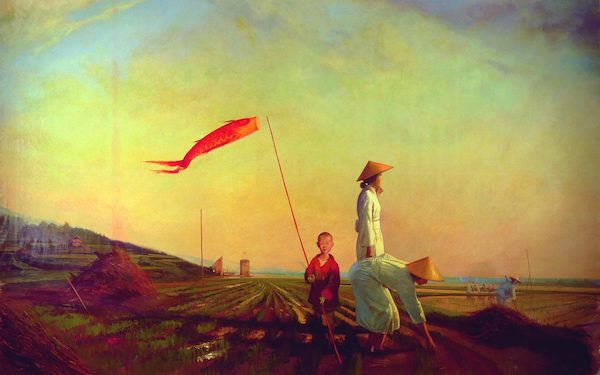 Hiroshima
A popular work at the Center, Hiroshima, showcases Bartlett’s incredible ability to collect stories and ideas and combine
them to form an image that tells a different but similar story. In the 1994 piece,
the viewer sees a woman looking off into the distance, and through the title, one
can allude to the fact she sees the blast from the nuclear bomb in Hiroshima from
World War II. This painting is able to capture an imagined moment of what may have
been experienced right before the bomb dropped.
Check out our artist talk for our exhibition, Hiroshima with Bo Bartlett
About the Painting
1994
Oil on linen
134 x 204
So in 1994, when I was in Swedesburg, I was going to do a whole series of war paintings.
I didn’t want to do war paintings glorifying war; rather, I wanted to do paintings
from the point of view of the feminine–the solution to war. A peaceful, non-violent
resolution. My first one was Hiroshima, and I had started it in grisaille. It was
going to be after the bomb dropped. I was doing some pre-internet research, and I
found John Hersey’s book Hiroshima, where he talked about one of the women who was
a survivor. She was in her house around 8:20 in the morning, and the “all clear”
siren had sounded. The neighbor across the way was tearing his house down shingle
by shingle. The mayor of Hiroshima had requested that people tear their house down
along certain roads to prevent fire from spreading throughout the town in the case
of a bomb being dropped. So people were choosing to sacrifice their houses for the
greater good. So she was watching him tear his house down, and her kids were behind
her on the mat, safely inside the house. And then behind him there was this yellow
flash–BOOM…. About twenty minutes later, she is waking up in the rubble and pushing
her roof off of herself. She stands up, and her house is gone. Her kids are gone.
Her neighbor’s house is gone. Every house in every direction is gone, and she is just
standing there in the landscape. So I used that story to represent the Hiroshima bombing.
I decided to back time up to before the bomb dropped. The Enola Gay is heading that
way, but it hadn’t dropped yet. I had already done the grisaille of all the dead figures
and the destruction, with all the houses blown over, but after reading that story,
I decided to bring it back and bring the yellow sky into the early morning light.
I put the woman in the field because I thought the action was more important. They
were picking rice in the field, and the “all clear” has sounded. They are standing
there, and the little boy is behind the mother with a carp kite, symbolizing courage.
The vanishing point is ground zero, the Peace Memorial of Hiroshima, way back there
in the distance you can see it. Also, the subjects are rather transparent because
of their impending disappearance.
–Bo Bartlett
Asian Conical Hat for Hiroshima
Bartlett had a few models wear this hat for studies for the painting, but was not
satisfied until a well-known American wood worker’s daughter, Mira Nakashima, was
introduced to the artist and wore it. After finding the right figures for this painting
Bartlett had two models wear robes on the Delaware River, near the artist’s Philadelphia
studio, at the same exact time the Enola Gay dropped the “Little Boy” atomic bomb
on Hiroshima – 8:16 am. He created a graphite study, in addition to many other studies,
and then reworked the figures to the position they are seen in the painting created
during his PEW Fellowship awarded in 1994.
Lifeboat
Thumbnail Drawings from 1998 Sketchbook for Lifeboat
A page from the artist’s 1998 sketchbook with thumbnails of paintings he was conceiving,
and working on, in various phases of completion, at the time. These thumbnails are
found in nearly all of the artist’s sketchbooks and were started in the late 70s and
are still practiced today.
This specific page shows thumbnails with a strong influence of water, and what would
become an important portion of his “Water” series. Bartlett was inspired by the Atlantic
Ocean off the coast of Maine on an island he owns, Wheaton Island, and where he, and
his family, visit every summer. Most of these thumbnails depicted became largescale
paintings, while “Water Skier” and “Big Trinity” never came to fruition.
Added to the bottom of the page is an idea the artist was working on for an entire
series of paintings regarding the five elements.
About the Painting
1998
Oil on Linen
80 x 100
This is probably one of my more successful paintings. I was up in Maine sitting at
what later became the Dip Net Restaurant, over at Miller’s Lobster Company in Port
Clyde. I was thinking about going out to the island and what I was going to work on
that summer. I looked up, and there was a print of Homer’s Fog Warning on the wall,
so I did a little drawing in my sketchbook of someone rowing a little lifeboat, sort
of flipping and turning it the other way and making it fresher and more modern. Then
I had everybody in my family pose for it. Man, Will, and I all posed for different
parts of it. We found different skiffs in Monhegan that I photographed, and I wound
up putting a boat on the grass and working from it, which is why it feels a little
bit like he is on a grassy hill. The joke title is “Mid-Lifeboat” because I was at
that point in my life when I was definitely mid-life. And it felt like this...the
seas were rocky, and there was always something over the next wave, just constant.
But if you look closely, The name of the lifeboat is “Jonah.” There is definitely
a shark in the water, and you can see it when you look at the real painting, just
under the surface. So there are threats everywhere. The wave in the back sort of becomes
a dorsal fin, and then the whole thing becomes a whale or shark. The white of the
boat becomes the underbelly and the head becomes the eye. It’s like this thing about
to start through the water and attack. So this was a sort of precursor to Leviathan,
which came later.
-Bo Bartlett
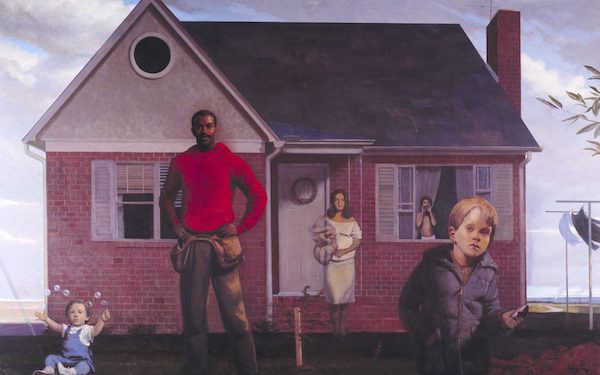 Object Performance
Painted in 1986, Object Permanence focuses on roles played in the artist’s life by himself and his own family over time.
The title alludes to the idea of objects existing even when you do not sense them,
something in which babies have not developed yet. Using objects and placement, Bartlett
alludes to impermanence in childhood and a family set apart, among other symbolic
gestures.
Check out our artist talk for our exhibition, Object Permanence with Bo Bartlett
About the Painting
1986
Oil on Linen
120 x 168
Bartlett’s childhood home appears in many of his works, and here it serves as the
backdrop to a fascinating family portrait. A father, mother and three children are
scattered throughout the composition, each framed by the structure of the house but
isolated from each other. The father figure is the artist’s self-portrait as an African
American. The pregnant mother holds a bundle, which is semi-transparent, symbolizing
the child not yet born. A boy in the front of the composition holds a Moon Pie, the
Southern delicacy that Bartlett himself had in his hand when, as a child, he fell
into the family pool and learned to swim. Another boy stands inside at the front window
and shouts, but no one hears him. The youngest child plays with bubbles, a classic
symbol for the impermanence of life.
For the artist, the elements of the painting relate to idea of object permanence,
which is the comprehension that objects are real even when they cannot be seen, heard,
touched, or smelled, an understanding that babies have not yet developed:
A child who doesn’t see his mother, who has perhaps walked out of the room, thinks
he will never see her again and starts crying. If the object is not right there in
front of you, it’s gone. So I tried to paint my house. A child is asked to draw his
family in school—the most basic thing they ask kids to do is to draw their world...their
family. So I was doing sort of a grown-up version of that: the simplest possible request
to represent what your life is.
Thumbnail Sketches of Object Permanence and Au Temps Series
On page 9 of Bartlett’s 1986 sketchbook, the artist depicts five thumbnail sketches
for what would become the central paintings of his Au Temps series. The artist has
placed titles under each of the thumbnails and annotated the top thumbnail with measurements
regarding the size he wanted all five of the paintings to be.
The top thumbnail titled Life depicts a house centrally located with figures seen
on the left side of the frame. This painting became Object Permanence. The next thumbnail
below Life is titled Resurrection Flight and it became Resurgere e Renasci. The thumbnail
below Resurrection Flight is titled Airplane and it became Tarmac. The bottom two
thumbnails are Death and Road, respectively, and the only title change of the two
was Road, which became Damascus Road.
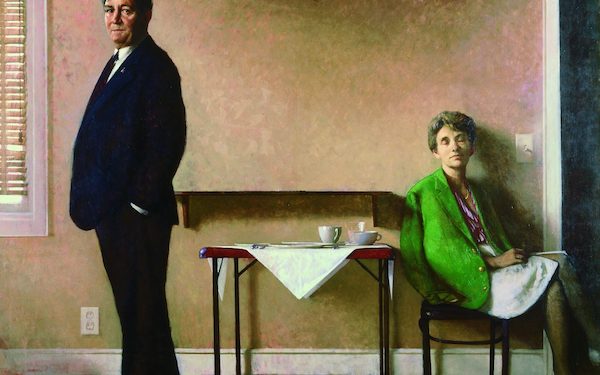 Parents
Parents is a painting made in 1984 that depicts Bo Bartlett’s parents in a setting he made
from recollections of his own childhood home life. He represents his father standing
and staring sternly, a man made from war and religion, and his mother almost in a
standby position. It is a scene with contrasting sides.
Check out our artist talk for our exhibition, Parents with Bo Bartlett
About the Painting
1984
Oil on linen
88 x 112
This painting of Bartlett's parents, set in the interior of his childhood home, is
an important early work in the artist's oeuvre. Included are several references and
quotations from art history, including the chandelier from Jan Van Eyck's The Arnolfini
Wedding Portrait, David Hockney's portrait of his parents, and John Singer Sargent's
portrait of Robert Lewis Stevenson and his wife, Fanny. Bartlett engages the familiar
trope of an active male and passive female found in all of these double portraits,
going so far as to his mother with her eyes closed.
"Marriage and balance and imbalance in relationships between male and female is a
recurring theme in my work. It has to do symbolically with the union of opposites,
the yin/yang, the structural and generative. The male and female are employed to represent
something else; even though [the subject] may on the surface be viewed as a couple
or a husband and wife, [the painting] is about the struggle for balance in the universe
as a whole."
Thumbnail Sketch for Parents
On page 15 of Bartlett’s 1984 sketchbook, the artist depicts a thumbnail sketch for
Parents in addition to two and a half drawings of an individual depicted from the side leaning
their face on the palm of their hand.
In Bartlett’s thumbnail, the artist stages the figures in identical poses as portrayed
in the final painting, but the space between them seems to be greater in the sketch.
Also, the female figure to the right in the drawing has a large portion of her legs
cropped out, like the female figure in the husband and wife portrait by John Singer
Sargent of Robert Lewis Stevenson and his wife. However, in the final painting, the
artist only crops out her right foot instead of most of her legs.
Sketchbook Drawings for School of Charm
Bartlett created these sketches for School of Charm in this 2009 sketchbook that is currently on display in the Cheves Archival Gallery
of the Bo Bartlett Center in an exhibition created by the artist titled Bo’s Brain.
The left side contains a detail of two of the figures, family members of the artist,
in the painting, while the right side contains a study of the room with the figures
in their approximate locations, social graces, and window signage.
About the Painting
2010
Oil on linen
76 x 90
One of a trio of paintings from 2010, this work explores Bartlett's childhood memories
of attending Mabel Bailey's School of Charm, which offered classes in poise and ballroom
dancing. In some Southern households of the 1950's, this instruction in good manners
was more important than the lessons learned in the elementary school (seen through
the large picture window), especially for girls. The work has been likened to a Norman
Rockwell Saturday Evening Post cover, and the pig-tails, red hair, and mischievous
smile of the central figure is reminiscent of the unrepentant figure in Rockwell's
Outside the Principal's Office.
"The whole thing started with the political atmosphere of everything being so contentious
in our society and people being so rude and not having manners anymore. I just remember
that when I was growing up they would teach you these things. For whatever reason,
it's just "not cool" to teach these kinds of things now. It's just considered so "old
school." But what a more civilized world we would have if we still taught that. I'm
not saying that in an old fashioned way, I'm just saying that we don't really respect
one another and we don't have manners the way we did in the past. There are surely
very important things that we must give our attention, but there are also elements
that make a culture civilized."
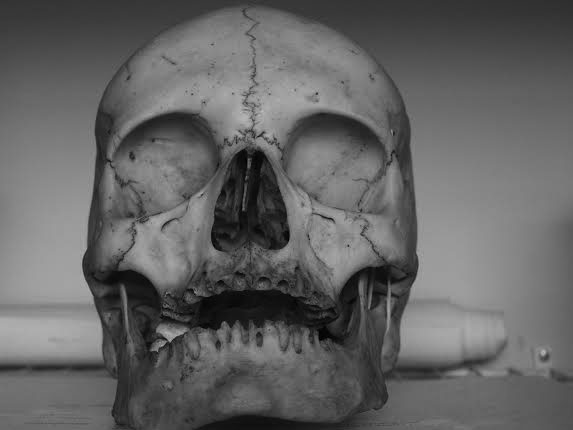 Skull
Skull
Originally mastered by Leonardo da Vinci and Michelangelo during the growth of arts
and sciences in the High Renaissance, anatomical drawings became crucial in creating
a more lifelike, sculptural portrayal of the human figure.
This importance resonated in Thomas Eakins. After becoming President of the Pennsylvania
Academy of the Fine Arts, Eakins did away with plaster cast models and brought in
live nudes to study, in addition to anatomical dissections.
Although initially starting an uproar at the Academy, and the dismissal of Eakins
as President in 1886, study of the live nude continued and has found its way in many
college level art classes across the United States.
Pennsylvania Academy of the Fine Arts Instructor, Louis Sloan (1932-2008), gave Bo
this skull to study and paint, knowing he studied anatomy and dissected corpses to
better understand the physical human form.
It was originally given to the academy from the Hospital of the University of Pennsylvania
for students to draw.
The artist now uses the skull to teach his students and to instruct during his Master
Class.
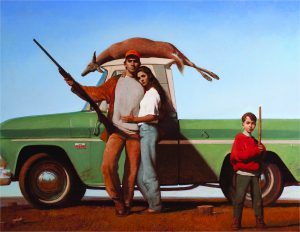 Young Life
1994
Oil on Linen
78 x 108
Painted while on a Pew, I was consciously doing a riff on “American Gothic”. My nephew
Grant and his girlfriend posed for studies in front of my father’s old Chevy pickup.
I morphed his girlfriend quite a bit. Grant’s father had brought deer he’d shot like
trophies into our living room in cardboard boxes while he was courting my sister.
I remember old black and white photos in the Ledger-Enquirer of my father with deer
across the hood of his truck. This was painted in Chadds Ford. I found a dead deer,
road kill, along Route 100. I put it in my trunk and slid it up the hill, splaying
it across a large old stump outside the studio barn door, painting it in several quick
days. It is a doe. It’s tail is embedded behind glass in the frame like a relic in
a Cornell box. The gun was inspired by Lee Harvey Oswald’s pose with his rifle when
he shot JFK. There’s a darker undercurrent of the painting, which was the era Bo grew
up in. There is mud that’s splattered, and blood on the pants and on the hands from
the deer. The innocence of the deer represents the loss of innocence. Religious and
tribal undertones are symbolized with the deer arching over the figures resembling
The Holy Family.
This painting is in the collection of the Ogden Museum of Southern Art.